Writing is the IELTS skill candidates spend the most time on and improve at the slowest. That's not a coincidence. Writing is the only criterion-scored skill where you don't get immediate feedback from your own performance. You finish an essay, you submit it, you wait. Without a trained eye reading it, you have no way to know if you wrote a Band 6 or a Band 7.
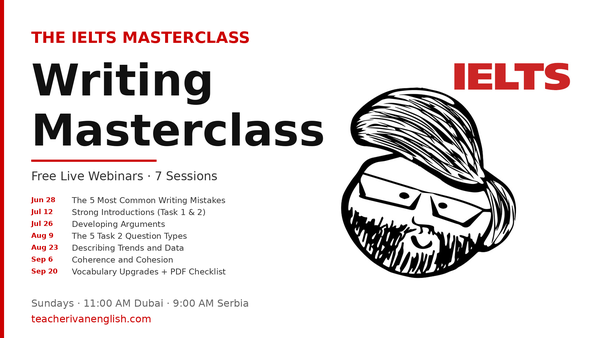
The Writing Masterclass solves that. Seven sessions across the summer, every one built around real student work scored live and rebuilt criterion by criterion. You see exactly what the examiner sees, exactly when they see it, on writing produced by people at your level.
The series covers essays, GT letters, and chart analyses. Sessions run every two weeks. Free to attend live. Once the series closes on October 5, the recordings move to the paid archive.
What changes after the series:
- You can identify the exact criterion that's holding your overall band down, and stop preparing for the wrong one
- You write introductions that score, regardless of task type
- You develop arguments instead of stating ideas
- You recognise the IELTS Task 2 question type before you write a single word
- You handle chart analyses with proper overviews, not data dumps
- You stop stacking basic linkers and start placing cohesion where it counts
- You walk away with a printable vocabulary checklist you can use on every piece of writing from that point on
The seven sessions:
1. The 5 Most Common IELTS Writing Mistakes (June 28)
The five mistakes that appear in almost every IELTS Writing submission, across essays, letters, and chart analyses. We diagnose all five live, show you what they look like in real student work, and give you the fix for each one. Most candidates make all five and don't realise. Fix them and your Band 6 becomes a Band 7, without learning new vocabulary or grammar.
2. How to Write a Strong IELTS Introduction (Task 1 and Task 2) (July 12)
Introductions across all three task types. Paraphrasing the prompt without copying it. Side-by-side comparisons of Band 5 and Band 7 introductions for essays, letters, and chart analyses. Students rewrite weak introductions live. Your introduction sets the examiner's expectation for the rest of your writing. Most candidates lose marks in the first two sentences.
3. Developing Arguments: How Band 7 Essays Build a Position (July 26)
The difference between stating an idea and developing it. Topic sentences. Supporting evidence. Examples that earn marks instead of filling space. Live argument-building exercises. This is the session that explains why Band 6 essays plateau, and how to push them through.
4. The 5 IELTS Task 2 Question Types: Why Most Candidates Answer the Wrong One (August 9)
There are five Task 2 question types: opinion, discussion, problem and solution, advantages and disadvantages, two-part. Most candidates write the same essay regardless of which they receive. Doing this destroys Task Response automatically and caps your overall band. We classify five real prompts live and outline the correct response for each.
5. Describing Trends and Data: The Task 1 Academic Chart (August 23)
How to analyse charts, graphs, and diagrams. Overview vs detail. The vocabulary of trends. Why "rose sharply" outscores "went up" and why "plateaued" outscores "stayed the same." Without an overview, Academic Task 1 caps at Band 5. This session fixes that.
6. Coherence and Cohesion: Why Your Writing Feels Disjointed (September 6)
What Coherence and Cohesion actually means across all three task types. Logical flow, cohesive devices, paragraph structure. The overuse of "however," missing topic sentences, unclear pronoun references. Why fewer linkers, placed inside sentences, score higher than four linkers stacked at the start of every paragraph.
7. The IELTS Vocabulary That's Holding You Back, and What to Use Instead (September 20)
The final session. The vocabulary problem isn't difficulty, it's precision. The words and phrases candidates use because they sound "academic" are the same ones that signal Band 5 to examiners. Overused linkers, vague hedges, misused academic words, empty intensifiers, register slips. 25–30 specific Band 5 to Band 7 upgrades across all three task types. Every attendee receives a downloadable PDF checklist with every upgrade from the session, organised by category, that you can use on every piece of writing from that point on.
Who this is for
You're preparing for IELTS Writing, Academic or General Training. You've plateaued somewhere between Band 5.5 and Band 6.5 and you're not sure why. You've studied grammar and vocabulary but your score won't move.
The Writing Masterclass answers why, and shows you exactly what to fix.